

A post-election market update, and why we have been replacing some mutual funds with ETFs
Unless you’ve been living under a rock, you know the midterm elections took over the news, and most of the commercial breaks, for the last few months. While some are cheering the results and others are not, the question we keep hearing is the same: what does this mean for the economy and my portfolio?
The short answer: we believe the economy is in better shape than the headlines suggest. Much of the volatility since Election Day has come from worries that newly elected officials will slow the AI build-out.1 Based on what they said on the campaign trail, some slowing is likely. We do not expect the build-out to grind to a halt, though. In our view, the race with China and the growth these projects bring are strong reasons for it to continue.
The economy still looks strong
In our view, the economy is ending the year on solid ground. It grew at a 3.4% annual pace in the third quarter,2 and there are several reasons why:
- The AI investment boom. Wall Street expects the five largest “hyperscalers,” the companies that build and run the giant data centers behind AI, to spend about $800 billion this year and roughly $1.1 trillion in 2027.3
- A resilient consumer. Consumer spending, about two-thirds of the economy, grew at a 3.8% pace despite higher prices and sticky inflation.2
- Productivity and jobs. Output per hour worked rose at a 3.6% pace,4 and employers added 165,000 jobs in October.5
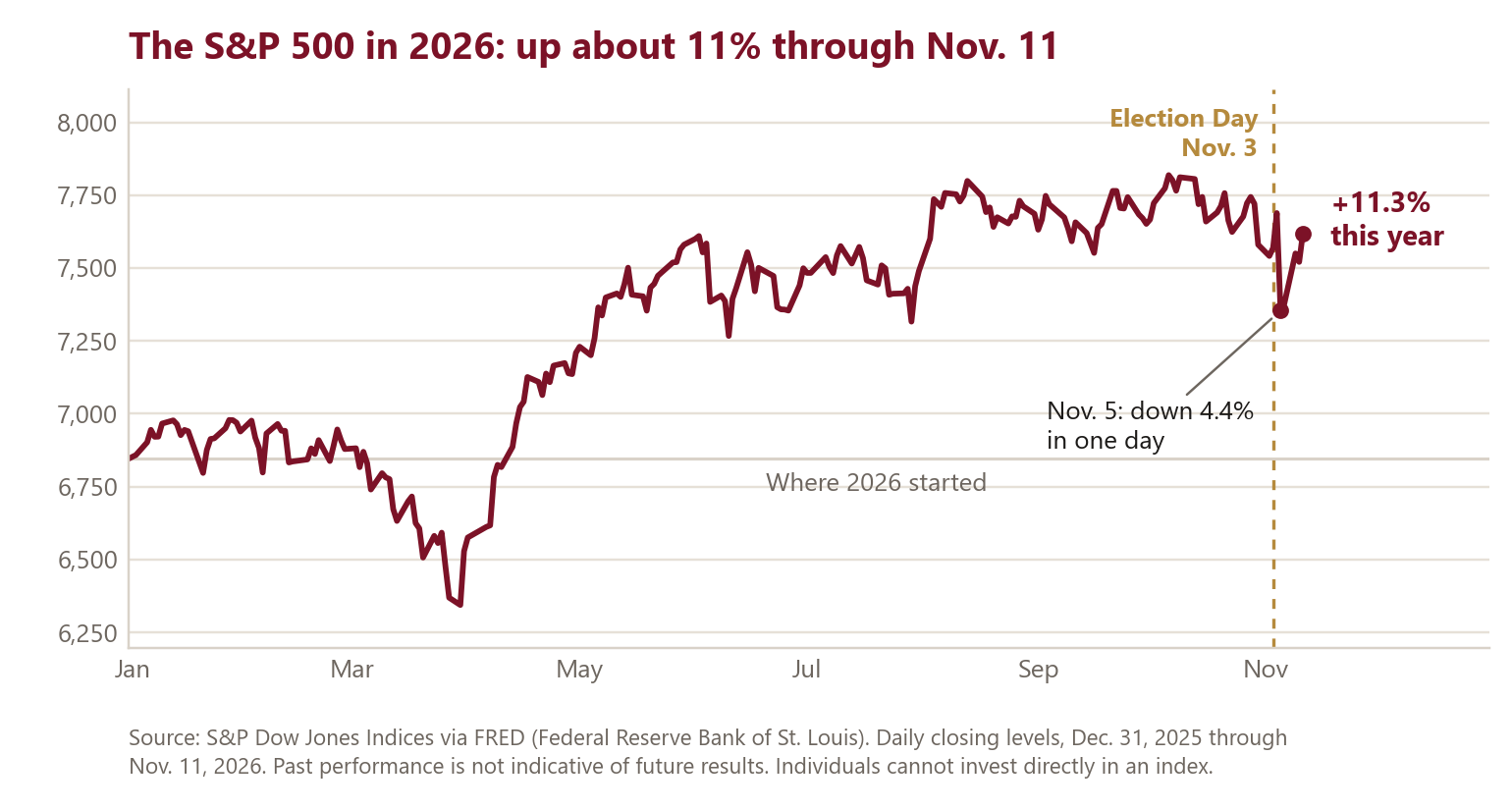
- Record corporate profits. Profits hit a record annual pace of $4.7 trillion in the second quarter,6 and the stock market has followed. The S&P 500 was up about 11% for the year through November 11th.7
- America’s built-in advantages. Low-cost natural gas,8 the U.S. dollar as the world’s most widely held reserve currency,9 and a culture that rewards people for starting businesses.
Of course, it isn’t all good news. The conflict with Iran sent oil prices higher this year.8 Consumer prices rose 3.7% in the 12 months through September, and gasoline is up more than a third.10 The Federal Reserve raised interest rates in September and could do so again in December.11 Those are the risks we’re watching most closely.
Where things stand · mid-November 2026
Washington is purple too
Democrats won both the House and the Senate, so starting in January the country will have a divided government: a Republican President and a Democratic Congress.12
That is more normal than it may feel. Since 1945, Washington has been divided about 60% of the time,13 which often means gridlock. Many investors welcome gridlock as a check and balance on both parties. History doesn’t promise better returns under either setup, though, so we don’t make investment decisions based on who controls Washington.
And of course, we expect more standoffs, starting with the December 11th government funding deadline.14 Uncertainty can cause short-term swings in the markets.
Why is Texas the state to watch?
Democrats had not won a statewide race in Texas since 1994.12 On November 3rd they won every statewide office on the ballot and a majority in the Texas House, while Republicans held the Texas Senate.12 One of the most prosperous red states in the country is now a deep shade of purple.
That matters to investors because Texas is the center of the AI build-out, with more data center capacity under construction than any other state.15 It is now a test case or proxy for how a state writes the rules for AI data centers. Governor Greg Abbott, a three-term incumbent, lost by about seven points to State Representative Gina Hinojosa,12 who campaigned on pausing new data center approvals until lawmakers pass new protections for electric customers, water supplies and local communities, plus union-labor requirements.16, 17
Markets moved both ways. The S&P 500 rose 1.6% the day after the election, then fell 4.4% on November 5th, its worst day since April 2025,7 as AI and chip stocks sold off on worries about the future of the AI build-out.1 By November 11th it was back above its Election Day close.7
So is this the end of data centers? We don’t believe so.
Most of next year’s projects are already being built. J.P. Morgan estimates that about three-quarters of the capacity due to open nationwide in 2027 is already under construction,18 and Morgan Stanley’s analysts wrote on November 11th that new governors are unlikely to disrupt those projects.19 The bigger question is 2028, when J.P. Morgan estimates about 40% of planned capacity could experience a pause.18
Prior to the election, both parties were already heading in this direction. In 2025, Texas lawmakers passed a law, signed by Governor Abbott, requiring the largest data centers to help pay for connecting to the power grid.20 In August, he paused new approvals while the state audits the projects in line.21 In our view, the likely outcome is transparent rules and a clear local and state approval process that developers can plan around.
Limits can help the companies that already have data centers. If new data centers become harder to build, the ones currently running could become more valuable, which may favor the hyperscalers that own them. A slower pace could also ease the pressure to keep spending and help their balance sheets. Several are now spending more on chips and construction than their businesses bring in, and all five have borrowed in the bond market this year.22
Other states want the business. Wyoming, Mississippi, West Virginia and Louisiana are all courting these projects for the jobs, investment and tax revenue they bring.1
The Texas Governor-elect’s plans are still taking shape. She has called for a moratorium on new permits, and after the election she told The New York Times she would also hold some permits that projects already underway still need.23 She takes office on January 19th.12 Until then, we’ll keep watching how our newest purple state works out its relationship with the future.
What we have changed in portfolios, and why
The election doesn’t change how we believe your money should be invested. Many of you have seen trades in your accounts in recent months, though, and we want to explain why.
Over the last decade, many of the portfolios we manage were built with mutual funds. We regularly review those mutual funds against their mutual fund peer group, and when one has fallen short, more and more often we have replaced it with an exchange-traded fund (ETF). An ETF holds a basket of stocks or bonds, similar to a mutual fund. However, its shares trade on an exchange during the day. Many ETFs now have three years or more of investment performance behind them, which makes it easier to compare them with the mutual funds we hold.
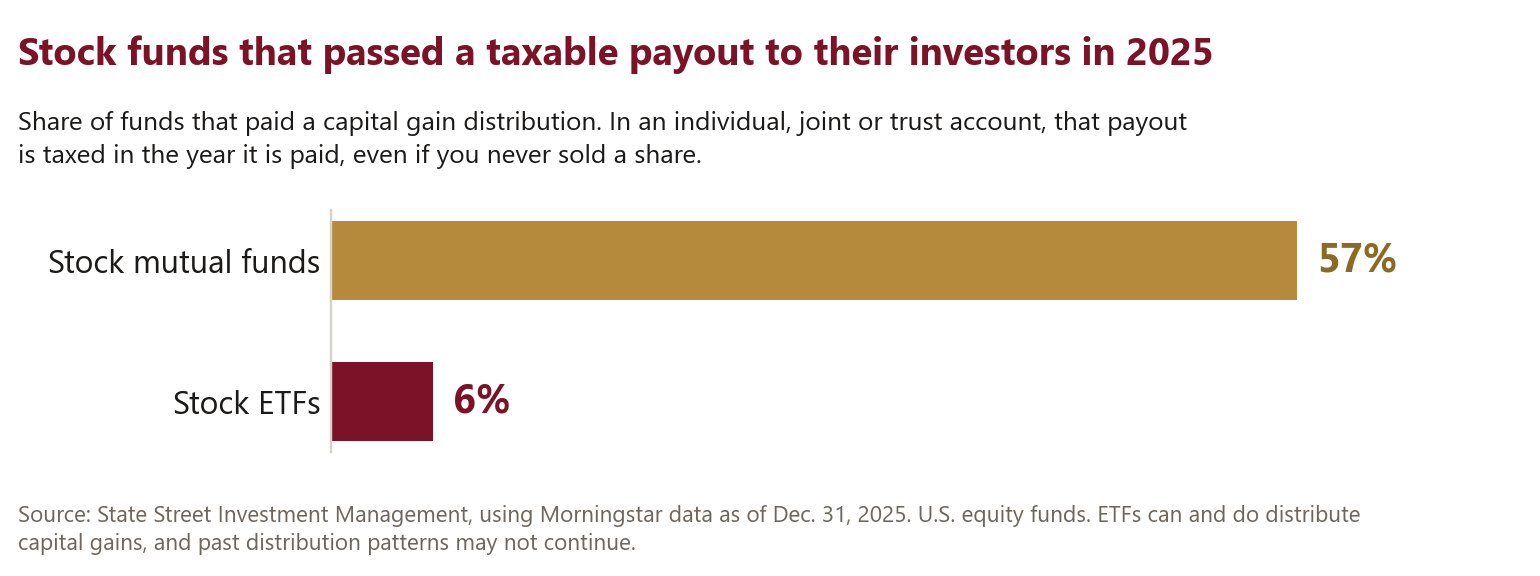
Taxes are a second reason. Many actively managed mutual funds are expected to pay large capital gain distributions this year, and a few expect to pay out a quarter or more of their value.24 Investors have been pulling money out of these mutual funds, and to raise the cash, a mutual fund has to sell stocks that have grown in value for years.24 The gains are passed on to the shareholders who remain invested in the mutual fund, and in an individual, joint or trust account you owe tax on that payout even if you never sold a share. By comparison, in 2025 about 6% of stock ETFs paid out a capital gain, versus 57% of stock mutual funds.25 ETFs aren’t tax-free, and some still pay out gains, but holding more of them may help lower your taxable distributions in future years.
So in recent months we have replaced some long-held mutual funds with ETFs where we believed the change made sense. For some clients we also use direct indexing. That means owning the individual stocks of an index in a separately managed account, where losses on some can help offset gains on others. It has account minimums and fees of its own.
A few points to keep in mind:
- You do not need to do anything. Where you have given us written authority to trade for you, the changes we have made appear on your statements. In accounts that require your approval, we do not trade without it.
- Our aim was to keep your mix of investments the same, or very close to it. Each ETF fills the same role as the mutual fund it replaced, though it may be managed differently.
- In individual, joint and trust accounts, we reviewed each change account by account. Selling a mutual fund can create a taxable gain of its own, sometimes larger than the payout it avoids, so we weighed each mutual fund’s year-end estimate against the tax cost of selling. In some accounts the right move was to continue to own the mutual fund.
- In IRAs and other retirement accounts, these trades did not create a tax bill. A change there was only about which investment we believed was the better fit for your portfolio.
If you’d like to know which of your mutual funds were part of this, or have any other questions, please don’t hesitate to call us. And if you’d like to update your financial plan or make changes before year-end, we’re glad to meet in person or by Zoom.
Texas may be purple now, but your plan doesn’t change color with every election. We hope you enjoy the holiday season, and we look forward to seeing you soon!
The Lightship Wealth Strategies Team
Sources
- Associated Press (Nov. 5, 2026).
- U.S. Bureau of Economic Analysis, third-quarter GDP, advance estimate (Oct. 29, 2026).
- Wall Street consensus estimates of capital spending, as reported by The Motley Fool (Nov. 12, 2026).
- U.S. Bureau of Labor Statistics, productivity (Nov. 5, 2026).
- U.S. Bureau of Labor Statistics, employment (Nov. 6, 2026).
- U.S. Bureau of Economic Analysis, corporate profits (Sept. 30, 2026).
- S&P Dow Jones Indices, S&P 500 closing levels through Nov. 11, 2026.
- U.S. Energy Information Administration (Nov. 10, 2026).
- International Monetary Fund, currency reserves (Sept. 30, 2026).
- U.S. Bureau of Labor Statistics, consumer prices (Oct. 14 and Nov. 10, 2026).
- Federal Reserve, statements of Sept. 16 and Oct. 28, 2026.
- Associated Press and Texas Tribune, election results as of Nov. 12, 2026. Some races remain uncalled, and Texas results are unofficial until certified.
- U.S. House and Senate party-division records (1945 to 2027).
- Public Law 119-103, federal funding through Dec. 11, 2026.
- Baxtel, data center capacity by state (Oct. 13, 2026).
- KTAB-TV interview with Gina Hinojosa (Oct. 31, 2026).
- Gina Hinojosa campaign release (July 23, 2026).
- J.P. Morgan Asset Management, Eye on the Market (Nov. 4, 2026).
- Morgan Stanley Research (Nov. 11, 2026).
- Texas Senate Bill 6 (2025).
- Office of the Texas Governor (Aug. 3, 2026).
- Company earnings releases and bond filings (October and November 2026).
- The New York Times interview with Gina Hinojosa (Nov. 8, 2026), as quoted by Spectrum News Texas (Nov. 11, 2026).
- Morningstar (Oct. 27, 2026).
- State Street Investment Management (formerly State Street Global Advisors), using Morningstar data (Feb. 18, 2026).
The opinions expressed are those of Lightship Wealth Strategies as of November 2026 and are not necessarily those of Raymond James. Information has been obtained from sources believed to be reliable, but accuracy is not guaranteed. There is no assurance any trends mentioned will continue or that forecasts will occur, and economic and market conditions are subject to change. Investing involves risk and you may incur a profit or loss regardless of strategy selected. Past performance is not indicative of future results. Diversification and asset allocation do not ensure a profit or protect against a loss. The S&P 500 is an unmanaged index of 500 widely held stocks and is not available for direct investment.
The information contained in this article does not purport to be a complete description of the securities, markets, or developments referred to in this material. The information has been obtained from sources considered to be reliable, but we do not guarantee that the foregoing material is accurate or complete. Investing in a single sector, such as technology, may involve greater volatility and risk than a broadly diversified portfolio.
Mutual funds and exchange-traded funds (ETFs) are sold by prospectus. Please consider the investment objectives, risks, charges and expenses carefully before investing. The prospectus, which contains this and other information, can be obtained from your financial advisor. Please read it carefully before investing. ETF shares trade at market price, which may be higher or lower than net asset value, and brokerage commissions and bid-ask spreads may apply. ETFs can distribute capital gains, and past distribution patterns may not continue. Direct indexing is offered through separately managed account programs that require account minimums and charge fees. A direct indexing portfolio may not track its index exactly, wash-sale rules can limit the use of losses, and tax-loss harvesting results are not guaranteed. Raymond James and its advisors do not offer tax or legal advice. You should discuss any tax or legal matters with the appropriate professional.
Raymond James is not affiliated with and does not endorse the opinions or services of J.P. Morgan Asset Management, Morgan Stanley, State Street Investment Management, Morningstar or Baxtel.
Securities offered through Raymond James Financial Services, Inc., member FINRA/SIPC. Investment advisory services offered through Raymond James Financial Services Advisors, Inc. Lightship Wealth Strategies, Inc. is not a registered broker/dealer and is independent of Raymond James Financial Services.