

On July 29, the Federal Reserve held interest rates steady for the fifth straight meeting. That part was expected. What happened around the decision was not. Three of the twelve voting members publicly dissented, each preferring to raise rates instead. That’s the most disagreement at a single Fed meeting in nearly a decade, and the new Fed chair seemed genuinely pleased about it.
“I asked for a good family fight, and I got one. That’s the purpose. That’s the design feature.”Fed Chair Kevin Warsh, press conference, July 29, 2026
If that sounds like a different kind of Federal Reserve than the one you’re used to, that’s because it is. The Fed has its first new leader in eight years, and he has wasted no time changing how the institution operates. Since a new chair comes along about once a decade, and since the Fed’s decisions ripple into mortgage rates, savings yields, and the value of nearly every investment you own, he’s worth five minutes of your time.
A new hand on the wheel
Kevin Warsh, 56, was sworn in on May 22 as the 17th chair of the Federal Reserve. He was President Trump’s choice to succeed Jerome Powell, and the Senate confirmed him 54 to 45, the narrowest recorded confirmation vote for the job. He’s no newcomer to the building, though. Warsh served as a Fed governor from 2006 to 2011 and was the central bank’s point person to Wall Street through the 2008 financial crisis, working alongside then-Chair Ben Bernanke on the responses to Bear Stearns, Lehman Brothers, and AIG.
One episode from that era says a lot. In November 2010, Warsh voted with the committee to approve the Fed’s $600 billion bond-buying program, known as QE2. Days later, he published a Wall Street Journal op-ed questioning whether it would work, warning it risked stoking inflation and distorting asset prices. He resigned a few months after that and spent the next fifteen years at Stanford’s Hoover Institution and in private investing. The through-line in his thinking, then and now, is skepticism that the Fed should steer markets as actively, and talk as much, as it has over the past two decades.
Now he runs it.
A quieter Fed, on purpose
For years, Fed-watching worked like this: the committee released a statement of 300-plus words, a chart of every official’s rate forecast (the famous “dot plot”), and broad hints about where rates were headed next, a practice known as forward guidance. Markets parsed every syllable.
Warsh is dismantling much of that, deliberately. His first policy statement in June ran about 130 words, compared with 341 at the meeting before he arrived; July’s ran about 150. Forward guidance is gone. The dot plot survives, though Warsh declined to submit his own forecast to it, and he has put the whole projections framework under review. His reasoning, in his own words: “Financial markets perform best when they react to incoming data… when all the financial markets are doing is reflecting back what we’ve said, then we’re taking the most important source of information and we’re being blind to it.”
He has also commissioned five task forces, staffed with outside experts including Harvard economist Raj Chetty and former Walmart CEO Doug McMillon, to rethink how the Fed communicates, manages its balance sheet, and measures the economy. Warsh hopes the Fed will be using new technology to read the economy “in a contemporaneous, real-time way” within about a year. To be clear about what that is and what it isn’t: the government agencies that produce the official statistics aren’t going anywhere, and Warsh has said the Fed owes them “a tremendous amount of respect.” The open question is what the Fed itself should watch.
The numbers · twelve months through June 2026
(the Fed’s 2% target measure)
(excludes food & energy)
trimmed mean
target range
Source: U.S. Bureau of Economic Analysis (PCE and core PCE); Federal Reserve Bank of Dallas (trimmed mean); Federal Reserve (target range). Data for the twelve months through June 2026, released July 30, 2026.
Two ways to measure the same prices
That measurement question is more interesting than it sounds, and it sits at the center of the Fed’s internal debate right now.
The Fed’s 2% inflation target is defined on a measure called PCE, which ran 3.7% over the twelve months through June. Because food and energy prices swing so much from month to month, economists have long watched “core” PCE, which simply throws those two categories out. Core ran 3.3% through June.
Warsh has spoken favorably about a third approach: trimmed-mean measures, like the one built by the Federal Reserve Bank of Dallas. Think of a teacher calculating a class average but tossing out the highest and lowest test scores first, so one outlier doesn’t skew the result. Each month, the trimmed mean looks at price changes across 177 spending categories, drops the most extreme movers on both ends, whatever they happen to be that month, and averages the rest. By that yardstick, inflation was 2.2% through June.
The challenge is a real one. A gap of a full percentage point between core PCE and the trimmed mean is unusual, and the people who know the trimmed mean best are urging caution about it. Lorie Logan, president of the Dallas Fed itself, said in mid-July that the current mix of price changes is likely making the trimmed mean read “lower than the true inflation trend.” She was one of the three votes to raise rates at the July meeting. And during the 2021–22 inflation surge, the trimmed mean was slow to catch what was happening, at times trailing core PCE by more than a percentage point on the way up.
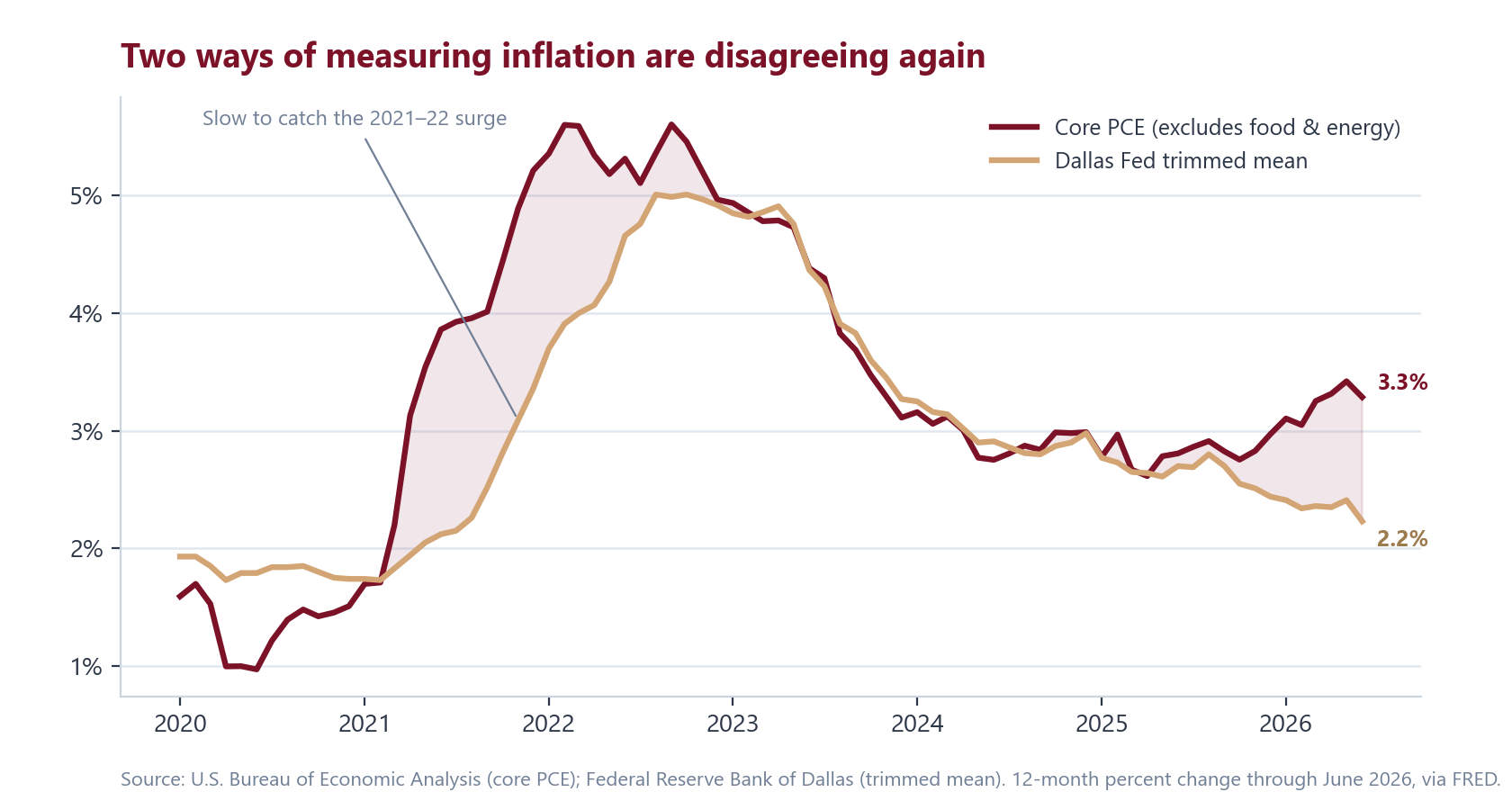
Switching measuring sticks doesn’t change what anything actually costs. It can change how the Fed explains its decisions, though, which is why this debate is worth following even if the answer eventually lands in a research paper instead of a headline.
What this means for you
A Fed that says less leaves markets to react to each piece of economic data on their own, without a script. We saw what that looks like at the July meeting. After the decision and press conference, stocks had their weakest Fed-day session in over a year and the 30-year Treasury yield touched its highest level since 2007. By the next morning, markets had steadied and moved on to a heavy day of earnings and economic reports. Sharper day-to-day swings around data releases are likely to be a feature of this era, not a malfunction.
Warsh has also been blunt that inflation is his priority, telling reporters there is “no soft inflation target.” Nine of the eighteen Fed officials who submitted June projections penciled in at least one rate increase before year-end. Whether that happens, nobody knows, and that’s precisely the point of the new style: the Fed is telling everyone, including us, to watch the data rather than wait for a promise.
Our approach doesn’t change, because it was never built on predicting the Fed’s next move. Diversification across stocks and bonds, cash set aside for near-term needs, and a plan tested against a range of outcomes: that’s what carries a portfolio through a noisier stretch. A few things we’re watching from here:
- The Fed’s September 15–16 meeting, and whether the push for a rate increase gains votes
- The task forces’ conclusions, expected around year-end, on how the Fed measures inflation
- Whether the gap between core PCE and the trimmed mean narrows or keeps widening
- Long-term Treasury yields, which set the tone for mortgage and borrowing costs
If the headlines around all of this ever have you second-guessing your plan, or something in your own situation has changed, please reach out. That’s what we’re here for.
A quieter Fed means louder markets. Your plan was built with both in mind.
The Lightship Wealth Strategies TeamLightship Wealth Strategies
Sources: Federal Reserve (FOMC statement and press conference, July 29, 2026; press conference transcript, June 17, 2026; task force announcement, July 9, 2026); U.S. Bureau of Economic Analysis (Personal Consumption Expenditures price index, June 2026, released July 30, 2026); Federal Reserve Bank of Dallas (Trimmed Mean PCE, June 2026; remarks of President Lorie Logan, July 16, 2026); U.S. Senate roll-call vote, May 13, 2026. Market moves per press reports of July 29–30, 2026.
The opinions expressed are those of Lightship Wealth Strategies as of August 2026 and are not necessarily those of Raymond James. Information has been obtained from sources believed to be reliable, but accuracy is not guaranteed. There is no assurance any trends mentioned will continue or that forecasts will occur, and economic and market conditions are subject to change. Investing involves risk and you may incur a profit or loss regardless of strategy selected. Past performance is not indicative of future results. Diversification and asset allocation do not ensure a profit or protect against a loss. U.S. Treasury securities are guaranteed by the U.S. government and, if held to maturity, offer a fixed rate of return and guaranteed principal value.
The information contained in this article does not purport to be a complete description of the securities, markets, or developments referred to in this material. The information has been obtained from sources considered to be reliable, but we do not guarantee that the foregoing material is accurate or complete.
Securities offered through Raymond James Financial Services, Inc., member FINRA/SIPC. Investment advisory services offered through Raymond James Financial Services Advisors, Inc. Lightship Wealth Strategies, Inc. is not a registered broker/dealer and is independent of Raymond James Financial Services.